On Human Relations with Other Sentient Beings
  • Home
  • The Blog

In Search of Veganism

7/15/2015

0 Comments

 
Picture
In November, 1944, there appeared the first issue of "The Vegan News." The organisation had a few dozen members, and the word "vegan" had just been adopted by Mr. Watson as one suggestion for the name of the new group. As a matter of passing interest, other suggestions included Dairyban, Alvegan, Vitan, Benevore, Bellevore, and some complicated titles like Total Vegetarian Group. (We should indeed feel relieved at the final choice!)

The editorial of the first " Vegan News" stated, "We can see quite plainly that our present civilisation is built upon the exploitation of animals, just as past civilisations were built upon the exploitation of slaves..." (This was an early hint that non-dairy vegetarianism was destined to be no more than one part of the general philosophy of the new movement.) The third issue (May, 1945) stated that veganism was the practice of living upon fruits, nuts, vegetables, grains and other wholesome non-animal foods. (It would perhaps have been more accurate to have said, not that veganism is, but that it involves, living upon such foods.) The fourth issue (August, 1945) stated, "The object of The Vegan Society is to oppose the exploitation of sentient life, whether it is profitable to do so or not." (This is a considerable widening of the original "non-dairy" motivation.)

The Vegan Society was formed in the constitutional sense on March 15th, 1947, when a special general meeting adopted for the first time a set of rules. There was, however, still no attempt to find an agreed definition of veganism. Rule 2, which laid down three of the many possible "aims" of the Society, was — and is — quite silent about many other aims which might equally be regarded as being "vegan." The stated aims refer only to diet, commodities, and the spreading of vegan teaching. They do not mention other aims which might equally be regarded as being vegan — such aims, for example, as opposition to hunting, vivisection, performing animals, and the castration and enslavement of animals for transport and other work. Above all, they are not, nor do they pretend to be, a definition of veganism.

LINK


"An Address on Veganism" (Donald Watson, 1947), contains phrases such as the following: "...the right approach to the problem of animal emancipation" ... "to be true emancipators of animals" ... "The vegan renounces the superstition that continued human existence depends upon the exploitation of these creatures," and " The time has come for us boldly to renounce the idea that we have the right to exploit animals." Similar ideas are embodied in the "Manifesto" on veganism and other writings. The thread that runs through the literature on this point is a conviction that for the sake of both man and his fellow creatures, the animals must one day be freed from his exploitations.

If vegan thought was running true, veganism is therefore a movement of reform. If this is accepted, it is but one step in simple logic to assert that The Vegan Society is at the earliest possible moment in duty bound to define veganism, and so state the over-all reform it wishes to see achieved. It is equally in duty bound to confine its basic energies to pursuing that reform. The position in which the Society finds itself — without any constitutionally agreed over-all purpose binding upon its members — is accounted for solely by the nature of its development to date. In this sense, the Society is still in a state of pre-natal growth. But this is not satisfactory as a permanency, for undefined reform is a contradiction in terms.

It is possible to subtract from the foregoing a number of observations which lead to a definition: (1) veganism is a reform; (2) the impelling element is compassion for animals arising out of the treatment meted out to them by man; (3) its fundamental concern is with the meeting point between the world of man and the world of the animals; (4) its existence presupposes maladjustment at that point; (5) its purpose must be the correction of that maladjustment; (6) the maladjustment is intimately connected with man's use of animals — more precisely, with his habit of acting as a parasite upon living creatures who cannot successfully resist his will. Any definition of veganism must contain these six observations and violate none of them.

LINK


Veganism, however, is a principle — that man has no right to exploit the creatures for his own ends — and no variation occurs. Vegan diet is therefore derived entirely from "fruits, nuts, vegetables, grains and other wholesome non-animal products," and excludes "flesh, fish, fowl, eggs, honey and animal milk and its derivatives."

In a vegan world the creatures would be reintegrated within the balance and sanity of nature as she is in herself. A great and historic wrong, whose effect upon the course of evolution must have been stupendous, would be righted. The idea that his fellow creatures might be used by man for self-interested purposes would be so alien to human thought as to be almost unthinkable. In this light, veganism is not so much welfare as liberation, for the creatures and for the mind and heart of man; not so much an effort to snake the present relationship bearable, as an uncompromising recognition that because it is in the main one of master and slave, it has to be abolished before something better and finer can be built. Veganism is in truth an affirmation that where love is, exploitation vanishes.

LINK


0 Comments

On Not Knowing

7/13/2015

0 Comments

 
Picture
What vegans know and what flesh eaters and vegetarians often deny.

Far more crucial than what we know or do not know is what we do not want to know.
Eric Hoffer, The Passionate State of Mind, 1954.


On Saturday March 24, 2001, the Welsh edition of the Liverpool Daily Post featured a single large picture on its front page. Under the headline ‘HEARTBREAK’ a man is pictured standing in front of a cow. The man’s hand is raised, the cow’s head is raised too, as if she is trying to smell what the man holds in his hand. The smell is likely to be metallic because the man holds a primed captive bolt pistol. The gun is pointed at the head of the cow who is locked into a large red restraining device. The subtitle under the headline reads: ‘The chilling moment which graphically illustrates the horrific reality of the farm outbreak’. The caption under the photograph reads: ‘GRIM TRUTH: A slaughterman shoots a cow in Lamonby, Cumbria, yesterday. We apologise to readers who find this photograph distressing. After much thought, we decided to publish it to show the full effect of the foot-and-mouth crisis’. 

Apart from the newspaper’s masthead, two adverts for the content of other pages and an advert at the bottom of the page for mobility scooters, the picture and the words above take up the whole of the tabloid-sized front page.

Albert Bandura (1990) has argued that ‘euphemistic labelling’ is commonly used to ‘mask’ objectionable activities. Something thoroughly ‘objectionable’ occurred regularly during the aforementioned British foot and mouth disease outbreak of 2001. The public saw, or at least had the opportunity to see - often several times daily - on both national and regional television and in all the nation’s press and every radio news bulletin - the mass media version of the killing and destruction of animals they normally encounter only as ‘meat’, or ‘hamburgers’ or ‘pork’ (see Agnew 1998: 184), or perhaps as ‘cute’ lambs or ‘contented’ grazing cows. Ted Benton (1993: 72, and see Plous 1993) points out, most people in the Western world usually purchase meat already commodified, packaged and often renamed. 

As might be suspected, many meat eaters do not overtly recognise themselves as purchasers of parts of the carcasses of dead animals, just as meat eaters and vegetarians may not have the fact that they are consumers of animal products at the forefront of their minds. Apart from the case of some fishes, care is generally taken to remove eyes and heads or other parts that would result in ‘meat’ being seen as a piece of an animal (when does a pig end and a pork chop begin? - see Singer 1983: 165-66).[1] How many recognise that the white liquid lined up on the shelves is, first and foremost, baby food: the food of calves? However, despite this, or because of these points, one question I pose here is relatively blunt: why should people take active steps to know any of the details about the animal products that they intend to consume? 

In fact, since even a moment’s thought on the subject might be expected to lead many individuals to make a guess at least that the deaths of or use of ‘food animals’ may not be particularly pleasant to witness, regardless of how ‘regulated’ the process may be, the question is rather: why shouldn’t people go out of their way to avoid knowing all there is to know about the animal-derived foods on their tables? Furthermore, what is more sensible than attempting to ‘mask’ known or suspected objectionable activities by euphemistic labelling or by other means? After all, is it not commonsensically assumed that the consumer of, say, pornography will likely avoid focusing on the potential suffering or harm involved in the ‘product’ they consume, and concentrate instead on the personal pleasure that derives from the consumption? Is it not at least appreciated that such consumers are liable to put any ‘known details’ of such harm and suffering to the backs of their minds, or interpret matters in such a way that serves to reduce the harm done? As consumers of pornography may assume that all those they view are volunteers, at least in some substantial sense, meat eaters and vegetarians likewise assume that animal welfare legislation ensures humane animal products. Philosophical appeals that informed adult human beings should regard themselves and act as reflexive moral agents are apparently not sufficiently powerful to prevent the purchasing and mass consumption of many products that cause harm. Complex social forces and understandings are in play here.

In relation to meat consumption, Singer (1983) notes that people, perhaps quite reasonably, do not want to know thedetails about the lives and deaths of the animals they are prepared to eat: for one thing, they do not want to spoil their dinner. After all, why should anyone want to spoil their dinner? Adams (1990) begins The Sexual Politics of Meat with a dedication: ‘In memory of 31.1 billion each year, 85.2 million each day, 3.5 million each hour, 59,170 each minute’. Apart from perhaps placing ‘9-11’ into something of a controversial context, these huge figures might easily spoil someone’s dinner, since the figures refer to the deaths of ‘food animals’ (current numbers require that at least another 12 billion should be added to the total amount cited by Adams, and that figure should be doubled if fishes and shellfishes are to be included). Why would anyone willingly put themselves ‘in the way’ of such statistics? Why would any meat eater know these things? Vegan animal advocates know more of these numbers than meat eaters know, but we should expect that. Those fighting against human trafficking are also much more likely to know more details about modern-day slavery than the actual traffickers.

Toward the end of 2001, there was a lengthy discussion on an animal advocacy network about issues arising from the annual North American ‘Thanksgiving’ celebration. A non meat-eater had written in saying she was negotiating with family members about how the day should go; particularly, what was to be done about the traditional ‘Thanksgiving turkey’. Not wanting to spoil the occasion for others, the animal advocate was considering allowing her mother to have her way and visit brandishing a pre-cooked turkey. Her email was an apparent reflection of her anxiety about compromising her principles; but it also seemed to reveal her recognition, and even partial acceptance, of the cultural importance of a turkey dinner on this particular social occasion. 

There is the suggestion that ‘animal rights’ views in this case had the clear potential to disrupt and upset a hitherto not-especially-thought-about aspect of Thanksgiving: that is, the plight of the millions of turkeys killed for it. This appears to be a case in which some awareness truly had the ability to ‘spoil’ a dinner: and an awareness of the emailer’s views had made her relatives, perhaps for the first time, think about turkeys at Thanksgiving, rather than simply think about Thanksgiving Turkey. When Groves (1995) investigated the role of emotion in social movement activity about human-nonhuman relations, he found a similar situation. He found that animal activists were often accused of ‘spoiling’ happy celebrations and occasions, and it is clear that this generally means that pro-animal philosophy had made people directly think about certain aspects of their relations with other animals (ibid: 441). For example, one activist told Groves that friends, aware of his and his wife’s position on human-nonhuman relations, stated before a meal: ‘We’re not going to say anything about food in front of our kids’. If a child comes up and mentions something about meat, the activist says of his friends: ‘They’ll all look at us like ‘don’t start him thinking!’’ (ibid.) Groves also recounts how a North American female activist had caused her mother to be very angry when she did talk about the plight of turkeys during Thanksgiving. Her mother’s rage was at least partly prompted by the presence of the activist’s aunt and the potential of a spoilt meal. The activist states that she was told by her mother: ‘‘This is supposed to be a happy occasion. It’s Thanksgiving. You’re supposed to be thankful’. I said ‘I am thankful. I’m thankful I’m not a turkey!’’ 

Appreciating Degrazia’s (1996) suggestion that negating early socialised lessons may take a certain independence of mind, it is further appreciated sociologically that any development of such independence of thinking is subject to, mediated, and controlled by forces of social interactions conditioned by social understandings surrounding any given issue. Sociologists Berger & Berger provide an interesting perspective on this sort of social experience as part of their ‘biographical approach’ to sociology. For example, they state that, “society is our experience with other people around us” (Berger & Berger 1976: 13) and that means that other people constantly mediate and modify human understanding of the social world. In a very real sense, they systematically impose and act to reinforce many of the norms and values of prevailing society. 

There may have been sufficient media coverage, especially in recent years, of various views about human-nonhuman relations for most people to know that continual claims are made about animal agricultural practices. Therefore, even some of the more radical positions have recently had at least the potential to make up part of the social understanding of such relations. However, there is absolutely no reason, apart from appeals for the evolution of ethical thinking, to suggest to people that they must actively engage with, or would want to evaluate, any such potentially disruptive claims. It may be further understood - and it seems essential that animal advocates fully understand this point - that a vague awareness of claims about the human treatment of other animals is likely to contribute to the belief, and the suspicion, that even a superficial enquiry about the ins and outs of animal use is at least likely to be psychically painfulas well as socially disruptive. There is growing evidence, briefly reviewed below, that it is extremely common for the vast majority of people to attempt, again ostensibly quite reasonably, to avoid such pain; perhaps especially if new claims may disturb long-held views about the appropriate treatment of other animals by humans. Much of the following section, then, is based on Stanley Cohen’s (2001) book, States of Denial: knowing about atrocities and suffering, and the work of Kevin Robins (1994). However, initially, an account of a phenomenon Keith Tester (1997: 32) calls humanity’s ‘learning curve of indifference’ is offered. Tester suggests that modern ‘knowledge denial’ can be understood, at least in part, as the result of developments in information technology and the immediacy of ‘knowing while not knowing’. 

Humanity’s ‘Learning Curve of Indifference’, or Knowing While Not Knowing

Tester notes that, regardless of where and when they take place, it is now virtually impossible not to be almost instantaneously aware of the occurrence of horror and suffering, and of the minute details of many of the modern world’s wars and calamities. At least it is true to say that the technology exists which makes this awareness possible on an increasingly global scale.[2] Of course, sociologists take a great interest in globalised social change and many have been keen to understand the societal effects of new developments in communications technology. Numerous studies have focused on technological change and the resulting transformations in work patterns and political attitudes (Goldthorpe, et al, 1968; 1969; Blauner 1972; Gallie 1988), while other sociologists have attempted to place such change on a continuum between conceptualisations of technological and social determinism (Zuboff 1988; Grint 1991). 


Tester (1997: 22) partly concentrates on the moral implications of technological developments. He cites the existential experience of Max Weber’s brother, Alfred, who was acutely discomforted when, in 1947, he found wars that had previously taken something like six months to be reported were now immediately broadcast on his new radio: ‘served up to us piping hot’, as he put it. Modern warfare, Weber continued, seemed to be ‘going on in the same town, almost in the same room’ (cited in ibid.) Although such experiences are almost routine for many twenty-first century citizens, Alfred Weber was rather shaken up by this ‘conquest of space’ and time. For him, the world had dramatically and rapidly become much smaller. It is one thing to know of far-away countries; it is quite another to suddenly become emotionally and morally involved in their day-to-day dealings. For Weber, the conquest of space and time meant that individuals could hardly be alone again. 

The consequence of this is twofold, he thought. On the one hand, an individual becomes transformed into a knowledgeable ‘citizen of the world’ but, on the other hand - and more terribly, knowledge can result in individuals suffering from what Tester characterises as ‘a surfeit of consciousness about the world’ (ibid.: 23). Thus, Weber is far from welcoming his new form of knowledge. On the contrary, he would feel far more comfortable remaining ignorant of the Turkish war in question. Weber suffers personally due to what Giddens calls the ‘intrusion of distant events into everyday consciousness’ (Giddens 1991: 27, emphasis in original). Tester, following the analysis of the mass media provided by both Giddens (1991; 1994) and Roger Silverstone (1994), argues that it is possible to view Weber’s experience as common to many, indeed most, individuals. Giddens’ view, as developed by Silverstone, places Weber as a subject of ‘late modernity’, experiencing a process of ‘detraditionalisation’; listening to news on his radio, and suffering from ontological insecurity. Feeling the sensation of ‘disembeddedness’ due to new knowledge, Weber is trying desperately to make sense of it all. 


However, Tester is keen to suggest that Weber is not ‘one of us’ at all (1997: 26). Acknowledging the problems in lumping whole groups of people into one category, Tester nevertheless argues that ‘we’ are currently further down the ‘learning curve of indifference’ to the horrors of the world than Weber was in the 1940’s. As a result, ‘we’ generally do not respond to knowledge of wars and horrors in the manner that Alfred Weber did. Of course, there are spectacular exceptions to this, even in modern times, and now the ‘Events of September 11th’ stands as the most immediate example. It is noteworthy that the attacks on the USA were shocking, yes – however, the fact that people could witness it live on global television networks was not. Nevertheless, ‘9-11’ cannot be seen as anything other than an extraordinary event, and Tester is claiming that Weber’s reaction to ‘everyday knowledge’ is remarkably different to most twenty-first century humans (ibid.) For, Weber was greatly moved by immediate knowledge - and particularly by the immediacy of the information he had acquired. The immediacy and startling newness of the medium by which that knowledge came to him meant that Weber felt he must try to make some sense of it. What was he now to think of himself? Of others? Of relationships?, and perhaps of new responsibilities? (ibid.: 27). Furthermore, cast into the role of a consumer of immediate knowledge perhaps better not known, at least not contemporaneously with events, Tester thinks Weber was left ‘struggling to come to terms with how he can possibly bear to know so much’ (ibid.) 

Thus, in the contemporary world of increasing and immediate access to a vast amount of ‘information’, Tester suggests that a strategy of ‘moral indifference’ has become an essential coping mechanism to enable individuals to deal with their new and rapidly increasing store of potentially painful and disturbing knowledge about the world. Therefore, what makes ‘us’ different from Alfred Weber is that we - unlike him - know exactly what to do with potentially painful knowledge: absolutely nothing (ibid.) 

Of course, the point Tester makes here would absolutely outrage many of those people who are campaigning daily to close down vivisection laboratories and/or stop road developments, and perhaps even those who managed to plunge their hands into their pockets during events such as Live Aid and ‘Red Nose Day’, precisely because it was knowledge relating to these issues and events which they claim spurred them on to act. The point would also likely get a cool response from those participants in the recent wave of ‘anti-capitalist’ demonstrations who follow ‘world leaders’ around the globe to make their protests, or those who have demonstrated to stop the ‘war on terrorism’. However, Tester could conceivably reply (as pessimistic Frankfurt School-inspired critical theorists may) with the suggestion that the overall numbers of people who attend such protests and demonstrations, drawn as they often are from several countries, are relatively very small. Smaller numbers than those who attend sporting events week-on-week, or the numbers found at the shopping malls pursuing the latest ‘must have’ necessities. 

In many - perhaps most - sociological accounts, the tension of generalising from the particular are evident. It is unlikely that any so-called metanarrative captures the experience of all, as no individual case can ever be seen as precisely the same as others. Tester seeks to generalise about humanity’s indifference, contrasting that with Weber’s response as an individual, and presumable with many currently engaged in social movement activism; and wisely he acknowledges the difficulties involved. However, he is suggesting that the generalised modern ‘we’ of today largely do not share Weber’s emotional response to new knowledge. For ‘we’ are used to living in a world ‘stimulated by the mediated surfeit of consciousness’ (ibid.: 26). 

If Weber’s reaction can be regarded as the result of hearing the piping-hot details of war and human suffering, Tester argues that modern responses to similar details are distinctly blasé and even akin to boredom. Any moral imperative incorporated into what is heard within systems of ‘global, 24-hour knowledge’ may now be entirely negated by notions of ‘compassion fatigue’. Unlike Weber, therefore, ‘we’ have heard it all before.


Overcoming Animal Pity

Bauman focuses on society-wide sentiments when he investigates the social construction of ‘moral distance’, and the availability of ‘moral sleeping pills’ (Bauman 1989: 26). He states that moral distance may be available for many people at different levels of involvement and awareness of harm-causing issues. 


Against the proposition that human beings are ‘naturally aggressive’ and violent animals (see Yates 1962; Lorenz 1977; Charny 1982), Bauman starts with the suggestion that human individuals have a strong and innate aversion to seeing the suffering of others. Attempts to ‘overcome’ these innate feelings require an efficient, powerful, and sustained program of socialisation. Hannah Arendt (cited in Bauman 1989: 19-20), argues that humanity has a natural and almost instinctive ‘animal pity’ by which ‘all normal men are affected in the presence of physical suffering’. Philosopher Clark (1984: 42) says this sentiment of basic human solidarity can be also found in the work of Schopenhauer and Ruland, the latter’s 1936 book being called, Foundations of Morality. However, Bauman shows throughout his forceful sociological treatment of the Nazi Holocaust that effectively-utilised social forces and processes have the ability to shape, influence and eventually overcome this ‘naturally-present’ pity. 

Taking such ideas, and following Levinas’ Ethics and Infinity, Bauman explores - and reverses - a traditional sociological orthodoxy which suggests that society itself is a ‘morality-producing factory’. In contrast, he suggests, ‘Morality is not a product of society. Morality is something society manipulates - exploits, redirects, jams’ (Bauman 1989: 183, emphasis in the original). Exploring the notion of ‘overcoming animal pity’, Bauman (ibid.: 24) notes that it involves socially producing conduct ‘contrary to innate moral inhibitions’. In other words, against everything that this fundamental pity implies in relation to attitudes and behaviour, people can become the murderers of others in certain social circumstances and conditions. However, there are other factors involved, including the connivance of those Bauman calls ‘conscious collaborators in the murdering process.’ As I have sought to demonstrate elsewhere, socially constructed stories, not least that ‘enemies are other’, and especially that human enemies ‘are animals’, can produce a sufficiency of moral distance that, in turn, enables the serious harm or death of chosen victims. If social mechanisms exist to allow people to involve themselves in harm, Bauman states that other mechanisms exist to deliberately distance the majority from knowledgeable involvement. For this large group, they are effectively freed by this process from having to make difficult moral choices and freed from the need to directly ‘stifle’ animal pity for victims of harm: morally, they sleep or doze. 

Bauman notes that other writers, such as Hilberg, have argued that the vast majority play no direct role in the holocausts conducted in their name. Furthermore, even those who ‘administer death’ can be kept at some distance from the moral, physical and psychic discomfort of ‘direct’ knowledge. Thus, even the bureaucrats of the Nazi holocaust, apparently innocently, busied themselves composing memoranda, talking on the telephone and attended conferences. All this rather than being involved in firing rifles at Jewish children or pouring gas into gas chambers.

Bauman’s suggestion is that even were such individuals to make all the difficult and necessary connections between what they did and the existence of an organised genocide, such knowledge would remain (deliberately) ‘in the remote recesses of their minds’ (ibid.) Moreover, when connections between actions and outcomes are difficult to spot, who is going to criticise those who engage in a little ‘moral blindness’? After all, ‘Little moral opprobrium was attached to the natural human proclivity to avoid worrying more than necessity required’ (ibid.) Who is going to examine ‘the whole length of the causal chain up to its furthest links’? In sum, Bauman forcefully argues that societies can be other than morality-producing. Rather, social systems have the ability to be efficient manufacturers of those seemingly vital moral sleeping pills, with equally powerful social mechanisms for the production of ‘moral distance’, ‘moral invisibility’ and ‘moral blindness’.


In a State of Denial

It is likely that Stanley Cohen’s States of Denial
 (2001) will become essential reading for anyone wanting to know about the social psychology of knowledge evasion, issue denial, forms of moral blindness, or the social manufacture of the ‘moral sleeping pills’ referred to above. Although Cohen presents a great deal of psychological and sociological evidence about many various forms of denial, he wisely comments that ‘this is neither a fixed psychological ‘mechanism’ nor a universal social process’ (ibid.: 3). However, forms of denial have been extensively researched by cognitive psychologists who ‘use the language of information processing, monitoring, selective perception, filtering and attention span to understand how we notice and simultaneously don’t notice’ (ibid.: 6). There are also theories based on a concept known as ‘blindsight’ which suggests that parts of the human mind can ‘not know’ what is known in other parts. 

Cohen is keen not to lose the wider picture about denial, noting, for example, that, although data suggests that family members can become engaged in ‘vital lies’ about a range of abuse issues, it should also be recognised that reliance of forms of denial effect more than just individuals and families: ‘Government bureaucracies, political parties, professional associations, religions, armies and police have their own forms of cover-up and lying’ (ibid.) Current political events in Britain and the United States in relation to the fallout after the ‘successful’ war in Iraq may have served to highlight the validity of these words.

Accounts, Justifications and Excuses


It is when Cohen turns to the sociology of denial that his work is most directly relevant to thoughts about human-nonhuman relations. When it comes to understanding forms of denial, both psychological and sociological factors must be interwoven for the fullest picture to be drawn. In a chapter entitled ‘Denial at work: mechanisms and rhetorical devices’, Cohen (ibid.: 51- 75) gives a comprehensive account of sociological denial theory; ranging from C. Wright Mills’ observation in the 1940’s that motives cannot merely be regarded as ‘mysterious internal states’ that ignore social situations, to 1990’s feminist analysis of abusive situations, and other investigations of ‘bystander’ politics.

Cohen (ibid.: 58) points out that denial operates before and after the fact, so some verbal motivational statements become guides to future behaviour. Again, it would represent a serious error to regard any ‘internal soliloquies’ as entirely private matters: ‘On the contrary: accounts are learnt by ordinary cultural transmission
, and are drawn from a well-established, collectively available pool’ (ibid.: 59, my emphasis). Moreover, ‘an account is adopted because of its public acceptability’, which seems to support subcultural notions that alternative - that is, generally unacceptable - accounts may be adopted for ‘shock value’. Cohen says that it is socialisation processes that ‘teaches us which motives are acceptable for which actions’ (ibid.) 

As children, individuals learn that ‘accounts are needed’, and are frequently ‘required’, to explain behaviour. Commonsensically, it is those accounts that are likely to be accepted that are the least problematic. Cohen follows Mills in noting that different audiences may require different accounts, yet this, ‘far from undermining the theory, confirms the radically sociological character of motivation’ (ibid.) Some accounts can be said to be in the form of justifications, others can be regarded as excuses. Drawing on the work of Scott and Lyman and Sykes and Matza from the 1950’s and 1960’s, Cohen notes that:

Justifications are ‘accounts in which one accepts responsibility for the act in question, but denies the pejorative quality associated with it’, whereas excuses are ‘accounts in which one admits that the act in question is bad, wrong or inappropriate, but denies full responsibility’ (ibid.)

Therefore:


A soldier kills, but denies that this is immoral: those he killed were enemies who deserved their fate. He is justifying his action. Another soldier admits the immorality of his killing, but denies full volition for his action: this was a case of involuntary obedience to orders. He is excusing his action (ibid.: emphasis in the original).

Cohen’s in-depth exploration of forms of denial, mechanisms of rationalisation, vocabulary of motivations, and justifications and excuses, means that it is apparently clear beyond much doubt that ‘turning a blind eye’ does not have to mean ‘not looking’. Rather, it is more about not registering or actively avoiding what has been seen or what is known. Denial is often about ‘deflecting’, ‘redirecting’, ‘turning aside’, ‘dodging’, and ‘escaping’ from what is essentially ‘known knowledge’. It would not be surprising to discover that the grim details of human harm contained in States of Denial could potentially spoil someone’s dinner, although it is interesting that Cohen openly admits that he himself is ‘in total denial’ about animal rights issues (ibid.: 289). He states that he is in denial about environmental issues as well, which is a little ironic in that environmentalists such as George Marshall (2001) have begun to use States of Denial as a substantive source in accounts of the psychology of denial about issues such as climate change and global warming.

Cohen’s thesis is that denial can be common, and indeed a normal state of affairs, and he provides an account of his own denial about these two issues. Moreover, and this is something making Cohen’s position even more interesting and particularly relevant, he admits that it is not the case that he cannot see the coherence of the arguments presented by environmentalists and animal advocates. In fact he reports that he ‘cannot find strong rational arguments against either set of claims’ (2001: 289). Yet, emotionally, he remains largely unmoved and, he admits, ‘particularly oblivious’ about animal issues. For example, while accepting that animal experimentation and animal agriculture may involve the treatment of other animals that can be difficult to defend, he resorts to putting his ‘filters’ on. He therefore tells himself that some issues are not really anything to do with him; that there are ‘worse problems’ in a suffering world; that ‘there are plenty of other people looking after this’ (ibid.) In fact, he employs many of the rationalisations and techniques of neutralisation that constitute the substance of his own book. Finally, and animal activists will especially recognise this stratagem, he relies on attack as a form of defence, stating: ‘What do you mean, I’m in denial every time I eat a hamburger?’ (ibid.)

Cohen suggests that there is what he calls a ‘meta-rule’ in operation here, involving all the elements of his thesis, and many seen in Bauman’s work on the sociology of morality. This ‘meta-rule’ is obviously quite speciesist, but it is a rule that also seriously threatens the well-being of any human ‘stranger’. 

Can it be any surprise to discover that the meta-rule states that ‘own people’ should always come first? Can it be a shock that the meta-rule suggests that ‘extensions’ of moral concern beyond families, friends and our ‘intimate circle’ are uncertain? Humanity draws a moral line; establishes an ethical threshold and, on a pessimistic note for all social movement activists, ‘we cannot be confident that more information (or more dreadful information?) will change the threshold’ (ibid., brackets in original). Cohen suggests that the problem may not be the absolute lack of concern, suggesting that people tend to think that human suffering is not normal or tolerable; the difficulty may be a ‘gap’ between concern and action; a gap that regrettably does not show great signs of closing. 

Searching for some understanding of the lack of action against deliberately caused human suffering within Western democracies, Cohen notes that many individuals may indicate their moral concern (their ‘moral investment’) by supporting a portfolio of social movements, or events such as Live Aid; yet, in the case of Britain, future prospects for action may be ‘unpromising’ given that ‘new sectors of the population are born-again free-market individualists and chronically infected by the selfishness of the Thatcher years’ (ibid.) People of ‘the Left’ have a range of new social movements which have effectively ‘fragmented’ concern, he claims, and they are engaged in a trend that encourages competition ‘about which group has suffered the most’ (ibid.: 290). Cohen does attempt to be optimistic, or at least he says that a ‘more hopeful’ narrative of the recent ‘evolution of a more universal, compassionate and inclusive consciousness’ is possible (ibid.) This latter point may tend to resonate with activists ‘known’ and ‘met’ on email networks. Many, just like Henry Salt and many others before them, insist on keeping the interwoven nature of oppression at the front of their minds. 


Returning to knowledge denial, Kevin Robins’ (1994) analysis significantly adds to the themes developed here by similarly examining the interplay between individual psychology and social factors. Robins notes that recent work in media and culture studies have identified a ‘postmodern’ ‘active audience’ who consume products in ways that seemingly ‘empowers’ them. This relatively new view of media consumption - the notion of the consumer self - is seen in opposition to the 1960’s and 1970’s positions outlined by critical theorists such as Stuart Ewen and Herbert Marcuse who ‘saw consumerism as a ‘Corrupting Other’’. Robins cites Alan Tomlinson’s acidic comment on this ‘older generation’ of theorists, whose position Tomlinson characterises as ‘elitist’, ‘sad’ and even ‘menopausal’. 

However, if it is really the case that modern consumer culture should be regarded as ‘fun’, ‘exciting’, ‘novel’, ‘convenient’ and a ‘marvellously subversive space’ then, Robins asks, what happens when people consume ‘media products’ depicting, for example, the Bosnian war? In other words, what does the putative ‘empowered’ and fun-oriented ‘active audience’ make of something that ‘anguish, despair or compassion might be more appropriate responses?’ (Robins, 1994: 452).


Avoiding ‘Unpleasure’

Robins’ analysis appears to provide an interesting additional psychological and social psychological component to Tester’s and Bauman’s sociology. Bauman (1989) himself introduces this dimension through the work of the controversial social psychological experimentalist, Stanley Milgram (see Milgram 1965; 1974). However, Robins’ account begins with Freud’s notion that human beings are purposely and deliberately involved in carefully avoiding the experience of ‘unpleasure’. After all, human beings have historically been quite sensibly interested in self-protection. This protection has been achieved throughout the ages with the use of physical measures, but often what is equally important is psychic protection from fear and anxiety and protection from knowledge
. On the physical level, Canetti (1973: 266-7) acknowledges the ‘care’ and ‘cunning’ human beings have historically employed to protect their ‘naked and vulnerable’ bodies. They ‘fend off’ the things that they perceived to be harmful. They invented shields and amour, and built ‘walls and whole fortresses’, in order to try to feel invulnerable. 

Robins claims that defensive cultural barriers can also be constructed in which ‘forms of cultural organisation and expression have been mobilised to sustain the sense of invulnerable existence’ (1994: 454). When the going gets tough, it is not so much that humanity gets going; rather humans have a tendency to block out or hide from what they believe may be harmful, including knowledge of pain, death and that staggeringly elusive thing, ‘reality’. Robins cites Don DeLillo’s 1985 novel, White Noise, in which the author notes that ‘reality’ is something humans often try to get away from: and when it comes to pain and death, we think these are unnatural: ‘We can’t bear these things as they are’. Humans can also ‘know too much’, Delillo suggests using Freudian language, ‘So we resort to repression, compromise and disguise’ (quoted in ibid). Humans do this in order to be able to ‘survive in the universe’. 

Delillo argues that repression, compromise and disguise make up part of ‘the natural language of the species’ (ibid.) Indeed, Freud - who uses the term ‘repression interchangeably with ‘defence’ (Madison 1961: 15) - does state that the human need to avoid unpleasure may be regarded as even more important than the want of obtaining pleasure. Therefore, with regard to what they might come to ‘know’, human beings, just like Stan Cohen, are likely to employ essential and apparently effective ‘knowledge filters’ to help to screen out painful realities.[3] An alternative to this strategy, Freud suggests, is to attempt to transform reality with a substitute version. These strategies are able to diminish the impact of painful knowledge, as individuals find adequate methods of containing and controlling the pain of reality. A significant way of doing just this, recalling Bauman, involves distancing: keeping what is perceived as suffering at a distance, or perhaps placing illusion before ‘reality’. Thus, human beings appear able to recreate the world, and ‘recast’ unbearable features as something else, thereby able to essentially ‘remould reality’. Freud further argues that this process can apply to both the individual or social collectives.

Robins, however, feels he is still left with something of a puzzle. After all, apparently ‘post-modern’ consuming is notbased on hiding away from cultural products - or based on the requirement to block them out. On the contrary, go-getting contemporary consumerism is commonly regarded as ‘liberating’, ‘self-affirming’ and ‘fun’: even ‘therapeutic’. However, like Tester, Robins says (of television consumption), that there is little doubt that watching, ‘in our culture is to be exposed to violence, suffering and death’ (Robins, 1994: 457; compare this with Ignatieff’s [1998] optimistic account of the potential of television to increase the moral imagination). The conundrum for Robins involves working out what motivates consumption of, say, the ‘pain of war’ - when this particular consuming does not, on the face of it, appear to be ‘liberating’ or ‘fun’, while it does not initially seem to involve hiding away from the existence of painful knowledge. 

Noting that modern society is actually rather keen to sequester ‘the real experience of death’, he questions the motivations (and the effects of the medium) of this consumption and wants to know what uses or gratifications can the ‘active audience’ gain from this watching. He cites Slavenka Drakulic’s disturbing account of death in Sarajevo (Drakulic 1993), to illustrate that, if humans want to consume the pain of war, they can apparently ‘see it all’: the mother who has lost a child, the child’s body wrapped up in a sheet. Yet, apparently this is not enough: the camera rolls on, and the sheet is lifted for a full-colour, screen-filling, ‘close-up of death’. Also easily seen are pictures of beheaded human corpses - food for pigs and dogs - or skeletons, or children with no legs, perhaps sniper-killed babies, and a 12-year-old describing being raped.

Much can be said at this point, of course. For example, the number of ‘active consumers’ whose ‘activity’ would be to reach for the ‘off’ switch is not at all clear. Whatever their number, perhaps is it just as likely that they never switched on, say, a ‘serious documentary’ in the first place. Again, why should they? There is bound to be a whole series of ‘soaps’ or ‘postmodern’, ‘ironic’ (read sexist) comedies on another television channel. If not, the DVD acts as a safe standby. Robins notes that it has been suggested that people have watched war to genuinely gain knowledge; to drive their active concern (Debray 1992, cited in Robins 1994: 460). This is the way Keith Tester characterises Giddens’ and Silverstone’s perspectives on the experience of media consumption (1997: 28). Alternatively, it has been suggested that watching war is an example of ‘living through the deaths of others’ (Bauman 1992: 34), or perhaps an example of being glad that someone else has died (Canetti 1973: 265). In these senses, perhaps this ‘consumption’ can be seen to have elements of therapeutic value after all.


Evading Knowledge

Regardless of whether these views adequately supply information about ‘what’s going on’, Robins notes (1994: 458) that those who do willingly engage with this violent war material appear not be overly damaged by it. Perhaps surprisingly, audiences appear ‘relatively unscathed’ by their television wars and their encounters with screen violence, he says. Robins argues that this is something that still needs further explanation:

If it is difficult to fully understand why viewers choose exposure to pain and dying, perhaps we can say a little more about how, having once exposed themselves, they are able to escape the emotional and moral consequences of seeing and knowing (ibid.)

He says there is a need to ‘reorientate’ theory in relation to commonsensical view (and the view advanced by Giddens and Silverstone) of the rationalistic nature and motivations of information gathering. For example, ‘We take it for granted the desire to know’, Robins asserts. However, ‘We generally do not take account of, or even recognise the existence of, the equally strong desire to not know, to evade knowledge’. Human beings are thus sometimes in a situation in which they seemingly have to watch in order to know that this is the particular knowledge that they do not want to know. ‘In this context, consumption activity may be driven by the desire to create defensive barriers and to avoid or minimise anxiety. Such resistance will serve to screen out the reality of what is seen and known’ (ibid.: 466). Robins takes care to note at this point that he is not describing purely a phenomenon of individual psychopathology, ‘but rather a collective experience which is institutionalised as the social norm’. An informed critical theoretical mind would perhaps also inquire as to who benefits from this social norm. 

Robins simply argues for a theoretical level that moves beyond ‘the too simple choice between ‘passive’ or ‘active’ notions of consumers and viewers’ toward an analytical complexity that understands the hedonistic ideas of ‘consumption freedom’ within the constraints of social and historical structures (ibid.: 465-6). It may be taken from Robins’ analysis that even the open display of ‘knowledge consumption’ does not necessarily mean that knowledge is actually consumed.

Moreover, while understanding the desire - and the apparent practical benefits - of evading knowledge, it is something else to recognise that there may also be a perceived hopelessness of knowing. In this regard Robins states that, ‘to know some awful truth without the possibility of changing it can lead to utter despair’ (ibid.: 459). In her Bosnian research, for example, journalist Drakulic notes that watching the war in all its macabre details only seems to make sense if, by watching, ‘something can change for the better’. If the possibility of change is absent, then surely there is something obscene about the knowing? However, reintroducing the practicalities of knowledge evasion, there is an alternative interpretation to consider. Suppose that it seems that ‘changes for the better’ may realistically come about from gained knowledge but then, bringing about this change would necessarily involve some important lifestyle or political change? If this were the case, Robins suggests, such a change may appear to be very painful for individuals or for groups. For example, the BBC 2’s Newsnight programme reported in 2001 that the global market in chocolate was intrinsically linked with modern child slavery. Presenter, Jeremy Paxman suggested to a representative of chocolate manufacturers and retailers that they could, and indeed should, take action to break this link, with a nod toward the chocolate-buying public that they too were implicated as the consumers of unethically-produced goods. 

For determined ‘chocoholics’, then, knowledge evasion may definitely be called for in relation to this matter, perhaps requiring the formation of ‘defensive organisations’ designed to resist and refuse the knowledge that their ostensibly innocent enjoyment of a chocolate bar can result in serious human harm. However, as Bauman suggests (1993: 127, and see Varcoe and Kilminster 1996: 238-39), moral responsibility is subject to a high degree of ambivalence and ‘floatation’. Thus, how can an individual work out what is morally right when she is just one in a whole chain of people involved in any human enterprise? The actually chocolate bar held in the hand of the chocolate lover is hardly inscribed with suffering: how is she to know if the reports of child slavery are true? Out of date? Grossly exaggerated? In any case, who says her preferred bar is implicated? Why, why, should she even begin to try to find out? 

Moreover, what point is there in even attempting to work out morally correct conduct when we know in the ‘vanity of human efforts’ that whatever is done by one counts for little in the overall scheme of things. Even if one person decides to ethically ‘opt out’ (if she can work out what that actually entails), she knows full well that ‘another person would promptly fill the gap’ (ibid.: 19). There is surely some moral relief and a deal of certainty in a ‘free rider’ belief that ‘somebody else’ will do whatever another has decided not to: in such a complex and unsure situation, why make such a decision? When knowledge may be evaded, or its ‘disruptive possibilities’ may be contained, Robins argues that, ‘the known may be withheld from the process of thinking; it may exist as the ‘unthought known’’ (Robins 1994: 459). He also notes that Bion (1963) has suggested that humans can do other things with thoughts than think them! 

Nonhuman Animals


The intention at this point is to briefly outline the perspectives of one or two writers who have attempted to shift analyses, such as those above, to the experiential situation of billions of nonhuman animals and the consumers of their ‘products’. This is something some humanistic positions (such as that of Clare Fox of the Institute of Ideas) may regard as unwarranted, and more likely downright insulting. We began with Tester and Bauman - John Robbins’ (1987) position, which essentially advocates a vegan diet and lifestyle, contains some interesting parallels to their analyses. Robbins’ work is about the harm caused by the human consumption of the flesh of other animals and products such as the milk of cows and the eggs of chickens. In a section concerned with ‘knowledge denial’ and the effects of advertising campaigns, Robbins starts with the concentration camp experience of German pacifist Edgar Kupfer whose secret Dachau Diaries, the writing of which could have cost him his life, are now preserved in a special collection in the library of the University of Chicago (Robbins 1987: 122-3). 

Kupfer was apparently sent to Dachau because he would not fight. He was also appalled that his fellow Germans stood by and silently accepted the genocide which was happening all around. However, the situation was not quite as stark as it sounds put this way. For it was not the case that the majority of German people knew every ‘precise detail’ of the Holocaust. While Bauman (1989) describes the careful and purposeful steps taken by the Nazis to prevent such full public awareness, Robbins nevertheless maintains that ‘most of them, it must be admitted, preferred not to know’ (1987: 124) suggesting that, for many, the activities of the Nazis became an ‘unknown known’. 

Therefore, often voices such as Kupfer’s, who had risked so much to record his experiences on scraps of paper, were not so much silenced as simply not listened to. Robbins describes ‘a web of knowledge repression’ that can permeate such times. As seen above, however, this is an understandable and even entirely sensible situation designed to serve ‘a collective determination to avoid the immense pain that would have come from really seeing what was happening’ (ibid.) In language similar to Bauman’s, Robbins describes a ‘psychic numbing’, and a ‘narrowed awareness’ which the majority embraced:

While there were always some people who resisted, who did what they could to save the lives of those hunted by the Nazis, often risking their own lives in so doing, most others tried to ignore the horrors, tried to keep a stiff upper lip and pretend nothing amiss was happening. Though it was hard to avoid knowing at least part of the horrid truth, they found ways of blocking the impact. They busied themselves with other matters, conjuring up rationalisations, narrowing their awareness, and looking the other way (ibid.)

Of course Robbins’ intention is to draw parallels with what he calls the ‘process of denial’ in Germany in W.W.II and apply it to the present North American consciousness concerning health and environmental issues and relate it all to attitudes about nonhumans used in agriculture. He particularly focuses on the experience of Edgar Kupfer because Kupfer himself explicitly connected his own plight with that of other animals. Indeed, one of Kupfer’s essays is entitled, ‘Animals, My Brethren’, which was written in part in a hospital barracks in Dachau. Perhaps Kupfer was all for engagement rather than denial - even if it may be painful. Given his intent, it is therefore not surprising that Robbins highlights Kupfer’s case and tries to use it against knowledge denial he claims is ‘once again rampant’ (Robbins 1987: 124). He says human beings are all aware on some level that our world is in peril. Their life-support system, many people argue, is at the point of collapse. However, because it often seems too painful to think about these things: responses to this knowledge may often be to ‘block it out’ (ibid.) 

Pain hurts, deeply, and many are frightened. However, pleads Robbins, do not deny it, do not disconnect, do not filter out: do not isolate oneself from that which cries out for response. Such a plea can be found in just about every pro-animal advocacy book since Singer’s, first published in 1975. Indeed, it is possible to trace such pleading as far back as Henry Salt,[4] or to Rachel Carson (1963) and Ruth Harrison (1964). All contain calls to action. Robbins (1987: 125) asks his audience to ‘move beyond denial’, yet he immediately recognises the difficulties in doing just that. He says he has had to fight hard against his own tendency to ‘withdraw’ and ‘go numb’. How can someone struggle against something so large, something so immense? (ibid.) Recalling points made by both Bauman and DeGrazia, Robbins explicitly acknowledges that a supreme effort on his part was required to resolve to go on campaigning against intensive farming for the hurt it caused to humans and other animals. Gary Francione’s response to this ‘potential burnout’ question is praiseworthy. He says there is an element of self-indulgence in stopping to try to effect change. This is particularly true given that the animal rights movement is so young and so new. We are pioneers of the vegan-based animal rights cause, just as Donald Watson was earlier a pioneer of the vegan cause. In this sense, it is a little early to contemplate burning out or the engendering of too much frustration about how people will want to deny what we want to expose them to. What we need, at present, is to grow the number of ethical vegans, and thus to grow the numbers of pioneers of change. Consequently, the evidence presented above is not meant to suggest that we stand no chance of bringing about change, and it certainly is not part of the thesis that suggests that human beings are more social than rational. 

Rather, the evidence above provides the social context of our efforts for us to internalise and appreciate; it explain why social change is slow, slower than we would like, not that it does not occur; it suggests that some effort is needed to understand our audiences if we hope to influence them; and it suggests to me that a degree of reflexivity is essential as an ongoing stance of animal advocates.


[1] Keith Thomas (1983) notes a move away from presenting meat on the table complete with heads and in a similar form as when a living animal. Modern meat products are very carefully packaged, using colouring, gas and chemicals to increase ‘attractiveness’, all of which means that the finished product on the shelf seems to bear no relation to the animals it came from (see Walsh 1986; Gold 1988, chap three: ‘Meat & Drugs’).

[2] Given this statement, it is incumbent to acknowledge the sociological research that points out the reality that the information which is potentially available is ultimately controlled by media gatekeepers, regardless of technological developments (e.g., see Elliot 1972).

[3] Freud himself has been accused of screening out painful realities, such as his alleged knowledge of the sexual abuse of children (Rush 1996).

[4] Clark (1984: 209-10) provides one of the most detailed lists of Salt’s major writings. They are, 1896 (ed.), The New Charter, (London); 1899-1900, ‘Rights of Animals’, Ethics 10; 1901 (ed.), Kith and Kin: Poems for animal life, (London); 1921, Seventy Years Among Savages, (London); 1922, Animals’ Rights, (London); 1933, The Logic of Vegetarianism, (London).


Adams, C.J. (1990) The Sexual Politics of Meat: A Feminist-Vegetarian Critical Theory. Cambridge: Polity.

Agnew, R. (1998) ‘The Causes of Animal Abuse: A Social-Psychological Analysis’, Theoretical Criminology, 2(2): 177-209.

Bandura, A. (1990) Social Learning Theory. Englewood Cliffs: Prentice-Hall.

Bauman, Z. (1989) Modernity and the Holocaust. Oxford: Polity.

Bauman, Z. (1992) Mortality, Immortality and Other Life Strategies. Oxford: Polity.

Benton, T. (1993) Natural Relations: Ecology, Animal Rights and Social Justice. London: Verso.

Berger, P.L. & Berger, B. (1976) Sociology: A Biographical Approach, (rev ed.) Harmondsworth: Penguin.

Bion, W. R. (1963) Elements of Psycho-Analysis. London: Heinemann.

Blauner, R. (1972) Racial Oppression in America. New York: Harper & Row.

Canetti, E. (1973) Crowds and Power. London: Penguin .

Carson, R. (1963) Silent Spring. Harmondsworth: Penguin.

Charny, I.W. (1982) How Can We Commit the Unthinkable?, Boulder: Westview Press.

Clark, S.R.L. (1984) The Moral Status of Animals. Oxford: Oxford University Press.

Cohen, S. (2001) States of Denial: Knowing About Atrocities and Suffering. Cambridge: Polity.

Debray, R. (1992) Vie et mort de l’image. Paris: Gallimard.

DeGrazia, D. (1996) Taking Animals Seriously: Mental Life and Moral Status. Cambridge: Cambridge University Press.

Drakulic, S. (1993) The Balkan Express: Fragments From the Other Side of War. New York: Norton.

Elliot, P. (1972) ‘Mass Communications - A contradiction in terms?’, in D. McQuail (ed.) Sociology of Mass Communications. Harmondsworth: Penguin.

Gallie, D. (1988) ‘Employment, unemployment and social stratification’, in D. Gallie (ed.) Employment in Britain. Oxford: Blackwell.

Giddens, A. (1991) Modernity and Self-Indentity: Self and Society in the Late Modern Age. Cambridge: Polity.

Gold, M. (1988) Living Without Cruelty. Basingstoke: Green Print.

Goldthorpe, J.H., et al. (1968) The Affluent Worker: Industrial Attitudes and Behaviour. Cambridge: Cambridge University Press.

Grint, K. (1991) The Sociology of Work: An Introduction. Cambridge: Polity Press.

Groves, J.M. (1995) ‘Learning to feel: the neglected sociology of social movements’, The Sociological Review, 43, 435-61.

Harrison, R. (1964) Animal Machines: The New Factory Farming Industry. London: Vincent Stuart.

Ignatieff, M. (1998) The Warrior’s Honour: Ethnic War and the Modern Conscience. London: Chatto & Windus.

Lorenz, K. (1977) On Aggression. New York: Harcourt, Brace & World.

Marshall, G. (2001) ‘The psychology of denial’, Observer, Climate Change pull-out, October 28: 8-9.

Milgram, S. (1965) ‘Some conditions of Obedience and Disobedience to Authority’, Human Relations, 18(1).

Milgram, S. (1974) Obedience to Authority: An Experimental View. London: Tavistock.

Plous, S. (1993) ‘Psychological mechanisms in the human use of animals’, Journal of Social Issues, 49: 11-52.

Robbins, J. (1987) Diet For A New America. Walpole, NH: Stillpoint.

Robins, K. (1994) ‘Forces of consumption: from the symbolic to the psychotic’, Media, Culture and Society, 16: 449-68.

Rush, F. (1996) ‘The Freudian Coverup’, Feminism & Psychology, 6 (2) May 96, pp.260-313.

Silverstone, R. (1994) Television and Everyday Life. London: Routledge.

Singer, P. (1983) Animal Liberation: Towards an End to Man’s Inhumanity to Animals. Wellingborough: Thorsons.

Tester, K. (1997) Moral Culture. London: Sage.

Thomas, K. (1983) Man and the Natural World: Changing Attitudes in England 1500-1800. London: Allen Lane.

Varcoe, I. & Kilminster, R. (1996) ‘Addendum: Culture and power in the writings of Zygmunt Bauman’, in R. Kilminster & I. Varcoe (eds.) Culture, Modernity and Revolution: Essays in honour of Zygmunt Bauman. London: Routledge.

Walsh, J. (1986) The Meat Machine: The Inside Story of the Meat Business. London: Columbus.

Yates, A.J. (1962) Frustration and Conflict. New York: Wiley.

Zuboff, S. (1988) In the Age of the Smart Machine. London: Heinemann.

0 Comments

That Vision Thing: The Vision in Veganism

6/26/2015

0 Comments

 
Picture
It seems increasingly clear that what we may regard as the original vision of veganism has been lost. On the other hand, that vision, formed in the 1940s onwards, was incomplete and somewhat confusing due to understandable definition issues and the way The Vegan Society was formed.

Essentially The Vegan Society came into existence due to a rejection of its vision by vegetarians, and we can see that vegan co-founder Donald Watson was critical of vegetarianism from the start. He and others had recognised that vegetarianism was, at best, a half-way house - but it really makes no sense even by its own principles of not wanting to live without killing other animals.

The Vegan Society was formed in the 1940s and there was immediate pressure to show that a human being could actually survive by not consuming animal produce. I believe that this pressure resulted in a lot of writing about health matters and less on "the vision thing." There was also the small complication known as World War II.

So, we have hints, statements, sentences, in writings from the 1940s and 1950s that alert us to that vision.

Rather than thinking expansively about veganism, modern vegans and, tragically, modern vegan societies (including TAVS), seem content to look narrowly at what veganism is, or what it could be - or should be.

There is a current and, to me, very depressing emphasis on health and diet but even when vegans do talk about ethics, they seem to suggest that veganism is limited almost exclusively to human relations with other sentient beings.

That, I suggest, is to badly misread the past history of the vegan movement, and the deeper far-reaching aspiration of the founders of it. Indeed, I think we are often guilty of betraying the early vegan pioneers.

Even though they were caught up in early concerns about health, they did sometimes explain veganism to be a grand overarching view about the future of humanity; about our relations with other sentient beings, of course, but also about how we live on the planet, and how we could live peacefully with each other.

They talk about peace and "peace aims," about human evolution, and they hinted that veganism could be central to a radical view of humanity. With global climate change brewing to be such an issue, to continue what they began is even more vital. We have to campaign for veganism in ways that make clear its vision of non-violence, of peace, and of justice for all sentient beings.

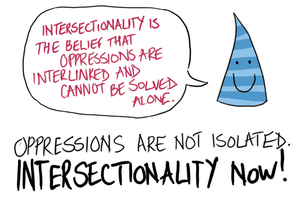
I believe that the early pioneers of the vegan movement thought in ways that we would now call "intersectional." Veganism, to them, was part and parcel of humanitarian aims. Humanitarianism has been described as "irresistible compassion" and "fellow-feeling," and is generally associated with concern about human rights and human welfare. I think they would be disappointed by the current vegan societies; the emphasis on human health, celebrity, and the endless pot lucks and "vegan cupcakes." 

The earliest vegan pioneers talked, albeit often in vague terms, about veganism being connected to the moral evolution of humanity. They seemed convinced that veganism in some way was concerned, not only to peace and justice, but to human fulfillment, if only we would stop oppressing others.

Some points early vegan pioneer Leslie Cross (1914-1979) makes are strikingly similar to David Nibert's domesecration thesis, that the "domestication" of other sentient beings is directly associated with human-on-human violence and oppression.

Do you agree that we need to continue the conversation that the early vegan pioneers began - and really sort out what we stand for in terms of scope and radical vision for the future?


I think such a conversation would remind us that veganism is a vision of different human relationships with other sentient beings, the planet, and each other.

0 Comments

Thoughts on Whether Animal Welfare Campaigns - and Many Welfare Organisations - are Even Needed. 

5/30/2015

1 Comment

 
Picture
What if animal welfare campaigns were not necessary? By welfare campaigns, I mean those that attempt to make cages bigger, or “push” the animal user industries to kill nonhuman animals in a way other than the traditional way, not the day-to-day activities of welfare organisations such as the RSPCA whose officers assist the police in breaking up dog fights and who rescue emaciated animals from fields and houses.

What if it turns out that clearly advocating the case for animal rights, veganism, and the total abolition of animal use, brought in its wake various welfare reforms? What if this means that no substantial monies or effort is needed in this area from those who say they stand for the abolition of animal use - and then the funds and energy could be devoted to campaigns against the real structural problem facing animal advocates, cultural speciesism.

Sociologist Richard Gale has looked at the complex and ever-changing relations that exist between social movement organisations (SMO) and countermovement organisations (CMO), and the connections that each has with the state or with state agencies. In terms of animal use, CMOs typically represent the industries perceiving themselves to be under pressure from the animal advocacy movement. The countermovement, this “counterforce,” to use Harold Guither’sterminology, is well funded and very powerful. For example, in the USA, an umbrella organisation such as the Animal Industry Foundation, “works to educate consumers about how modern livestock and poultry producers operate and the importance of their service to the American public.” This group represents the interests of numerous “producer groups, agribusiness associations, and agribusiness companies” such as the National Cattleman’s Association, the American Farm Bureau Federation, the American Feed Industry Association, the National Milk Producers Federation and United Egg Producers. 

Likewise, the Farm Animal Welfare Coalition (FAWC) was created to represent 45 industry groups and therefore was, “alarmed by the premises of animal activists, the criticisms of modern confinement livestock and poultry production, and the promotion of vegetarianism,” and worried (in public utterances at least) to the extent that it sees, “the animal rights movement as destructive to consumer choice and the farm economy.” 

Gale points out that there may or may not be direct communication between social movement organisations and their countermovement mobilisations but both will tend to attempt to gain access to, and have influence over, state agencies. Therefore, since it is nearly impossible to conceive of any major social movement activity that does not involve the state to some degree, adequate social movement analysis must be alive to “the social movement-countermovement-state triad.” What this means is that developments and discourse in civil society created by social movement activity, in this case animal advocacy, will create dialogue between state agencies and industry representatives acting as a counterforce mobilisation. Apart from close links that exist between governments and user industries, the latter often enjoying what political scientist Robert Garner calls “insider status”, when governments consult on animal issues, they invite submissions from user industry representatives, academics, and the most respectable of the traditional animal welfare organizations. There is no need for any animal rights input in such proceedings since animal welfare is the only criteria ever applied, be it in investigations into the regulation of the use of animals in circuses, on farms, in laboratories, or any other use setting. 

However, the impact of animal rights campaigning on public attitudes, and the amount of media attention given to animal rights advocacy, can and probably will become constituent parts of these deliberations. The efforts of the animal rights advocate, then, remains best expended at the civil society level, for example, in attempts to shift the way society thinks about nonhuman animals. Success in this sphere will inevitably result in welfare reforms along the way without the need for direct advocacy of it by animal advocates with aspirations beyond that of traditional animal welfarism.

Typically, of course, the animal user industries themselves respond to criticism from - or perceived to be from - an animal rights perspective with claims about animal welfare. The history of single-issue campaigning about animals enslaved in circuses is a classic example, although little of the claims-making is rights-based and is more in line with neo-welfarist orientations. While individual circus proprietors respond to demonstrations and claims-making about animal use with welfare statements, for example, here, here, and here, the circus industry, in consultation with government regulators, welcome - and advocate themselves - the regulation of circuses using animals. They do this because they know nothing beyond the notion of animal welfarism will enter into such deliberations. Therefore, while state-countermovement dialogue occurs on this level, both are likely to part-fund research about the pros and cons of different use systems. In other words, if they are to address animal use at all, they inevitably review it within the dominant paradigm of orthodox animal welfarism. This is what society does – it “understands” animal welfare because animal welfare suggests that “non-cruel use” is both feasible and desirable provided enough use regulation is set in place. Essentially, state regulators and countermovements are searching for welfare reforms that seems to satisfy prevailing public attitudes and also meet their primary objective of animal user industries not suffering economically.

This is where scientific disciplines such as animal welfare science play a vital role. Clive Phillips’ 2008 book, The Welfare of Animals: The Silent Majority, outlines the situation well. For example, Phillips recognises that a rapid intensification of animal agriculture occurred in the latter half of the twentieth century. At the expense of “family businesses” a new corporate enterprise emerged in “a new industrial farming sector,” bringing with it a fresh emphasis on economic imperatives. Phillips points out that there is “no universal truism that intensive systems are associated with low welfare and extensive systems with high.” Therefore, research is required into animal use systems. 

The adoption of welfare modifications are considered where appropriate and especially when they do not impact on profits. The result, according to Phillips, is that in most “developed countries,” industry funds research to meet two objectives. The first is to increase profits, “for example by control of diseases or an economically viable increase in productivity due to alleviation of stress,” and the second is in response to demands by the animal advocacy movement. 

In the latter case, industry insists that “such changes cannot be made without scientific evaluations of welfare impacts” and this research usually takes about ten years to complete. While Phillips points out that industry is reluctant to fund welfare research or implement changes if profits are threatened, there is one important proviso to this: “Of course even if profit is reduced in the short terms, in the long term a better market may be accessible if welfare is improved, such as to consumers paying more to purchase products from animals kept in high welfare systems.” 

Clearly those who profit from the use of animals are carefully and constantly monitoring their own business, as all successful businesses do. They are quite prepared to pay for research to keep them ahead of the game and profitable, and if that means employing experts such as Temple Grandin, they will. However, they also monitor the general discourse about the use of animals created by animal advocacy and, as ever, in league with their political allies, they will respond to rights-based claims-making to abolish animal use with suggestions and implementations of welfare reform. Since they always respond to animal rights with animal welfare, there is no need for specific welfare reforms to be advocated: industry experts and paid consultants will do that regardless. Such reforms will arise in the normal cut and thrust of social movement and countermovement exchanges, media reportage, and as a result of countermovement and state-level dialogue. 

Not only may it be the case that animal advocates who seek abolition of animal use need never advocate for particular welfare reforms, and stick to challenging the power of cultural speciesism, it is also likely that some welfare reforms are delayed by animal advocates demanding them, especially, as PETA did recently in relation to KFC and CAK, when advocates always loudly announce that they are successfully “pushing” business into making changes against business wishes (whether that is factually true or not). As in all political negotiations, none of the parties want others to claim “victory!” at their expense, leaving them vulnerable to the recriminations from within their own community, some of whom are likely to have had their interests damaged, leaving them feeling betrayed and dissatisfied.

As suggested, the overarching sociological reality that must be acknowledged is that animal welfarism is the dominant paradigm when it comes to assessments of the human use of other animals. The ideology of animal welfare, at least in terms of the “western world,” is deeply embedded into the structure of society and the psychology of its citizens. Generation after generation socialize their children to care about the welfare of animals while they use them, and generation after generation internalize these social lessons that amounts to animal use is not the issue. This is why all animal users virtually without exception claim to have the welfare of their animal property at heart; that they “love” the animals they use and commodify; and they are also just as critical as anyone else of cases that violate the basic principles of animal welfare. For example, those in the animal user industries are undoubtedly equally outraged about what Michael Vick did to dogs, and just as opposed to teenagers shoving kittens in microwaves, or people slashing horses in fields and stables as any animal advocate. However, they need not think outside of the principles of animal welfare to hold such views and, therefore, they need not think contextually about Vick’s diet or lifestyle, or consider a kitten-killer’s leather clothing, or a “horse ripper’s” love of ice cream and milk shakes made from the stolen baby food of mammal mothers.

The fact that animal welfarism is so deeply entrenched in the value system of society is also reflected in the general public response to animal rights. Those who grew up learning the tenets of animal welfarism and, believing the generalised welfarist promise of “non-cruel use,” can have a hard time understanding the claim that a rights-based approach to the human use of animals is necessary or desirable. Therefore, taken out of their comfort zone within the welfarist view, the general public also will respond to rights-based claims with thoughts about animal welfare. Likewise, “celebrity chefs” will do exactly the same. Such TV personalities, for example, Jamie Oliver and Hugh Fearnley-Whittingstall, have taken steps to improve the welfare of battery chickens and other “food animals.” 

However, since many animal advocates accept that only a paradigm shift in human consciousness about animals will bring about any meaningful benefits for them, and since many accept that the general societal reaction to animal rights is informed by the ideology and practice of animal welfarism, animal advocates who engage in animal welfare are merely working within the status quo - moving the pieces around the board - rather than encouraging the adoption of a brand new game. In the words of Donald Watson, vegan animal rights advocates must “ripen up” the population to the idea of animal rights, rather than expending time, money and energy on identifying “low-hanging fruit” which does little or nothing to challenge the property status of nonhuman animals. This conventional view of animals – that they are items of property – “its” to be owned - is, after all, a major problem that prevents their rights being respected. Engaging in welfarism inevitably strengthens the view that animals are items of property and does little to weaken prevailing attitudes.

Although many animal advocates claim to agree that no animal use can be justified, they claim that they must campaign for welfare reform as it is the only thing that it realistic at the present time. However, given the sociology and indeed the economics of welfare
 responses to rights-based claims-making, there are important reasons why making rights claims is the only rational response to animal exploitation. Let the users worry about the welfare of their captives, we have to win respect for the rights of nonhuman animals and convince people that use is a rights violation. The more successful we are in doing that, the more welfare reforms will flow from the ongoing relationships within the social movement-countermovement-state triad.

1 Comment

Palm Oil, Human Rights, and (DIY) Politics are Vegan Issues

5/23/2015

0 Comments

 
Picture
I’ve seen numerous discussions in recent months about the question – “is palm oil vegan?” This raises the issue of what makes anything “vegan.” “Is it vegan?” is a common enough question within the animal rights community.

What, however, is being asked when the question asked is, “is it vegan?” Does it mean that “it” contains no parts derived from other animals? – or does it mean that “it” is a product or something that vegans who recognise veganism as an ethic and not a diet can be happy and content with?

When we ask, “it is vegan?,” are we merely concerned with a list of ingredients, or do we have a much wider remit that is interested in how and in what circumstances were “it” – or the ingredients of “it” – obtained and produced? It seems to me that vegans are interested in that much wider question – we want to know if the item “contains” suffering: we should want to know if rights violations were involved in the making of the item.

Since its inception in 1944, veganism has been seen by many vegans [1] themselves as a proper and constituent part of radical social movements working towards peace, fairness, social justice, non-violence, anti-discrimination, and so forth.

This means that palm oil is not vegan. Like the famous Irish drink, Guinness, palm oil contains no animal ingredients, that is true, but its current method of production results in suffering and rights violations. Such a product cannot be vegan by definition. A product may be made entirely from plants but that does not make it vegan. Something that arises through the suffering of others, through others having their rights violated, cannot correspond with efforts towards peace, non-violence, and justice. It does not correspond with the thrust of the philosophy of veganism.

The suffering of others includes the suffering of other humans.

Donald Watson is the best-known co-founder of the British Vegan Society and he saw the vegan movement and the peace movement as intertwined. Perhaps as a forerunner to the more developed idea of alliance politics, he suggested that many people will become vegan as part of their “peace aims.” His brother and sister also went vegan and became conscientious objectors in WWII as Watson himself did. When Watson spoke about important social movements, he also seemed to talk about veganism and the cause to end human slavery as interlinked and having similar aims. He believed that the vegan ethic “covered” other social mobilisations, including movements that saved human lives, declaring a “soft spot” for lifeboat and mountain rescue personnel, especially because they are all volunteers.

He suggested that veganism is a humanitarian movement that provides members the opportunity to express the things they “stand for” in life; a radical social movement that may alter humanity for the better, and help to increase the very survival of the planet. He argued, therefore, that we need to take a broad view about what veganism is and about what it means. Vegans must think beyond diet, he said, and realise we are part of “something really big;” that vegans are engaged in a pioneer movement that will aid human evolution and the “moral development” of humankind. Believing that veganism will help to bring about a different sort of human being, he plainly thought that human animals matter. Watson suggested that vegan ethics will bring forth a new “civilisation,” and perhaps forge for the first time in human history a world and a humanity that truly deserves that name.

He said that vegans go beyond “live and let live” and believe in the notion of, “live and help live.” This means, he argued, that veganism includes caring about the exploitation of all sentient life.

While Donald Watson’s BBC News obituary correctly describes a vegan as someone who “eats a plant-based diet free from all animal products including milk, eggs and honey,” and points out that, “Most [sic] vegans wear no leather, wool or silk,” it is clear that Watson saw veganism in much broader terms than this dietary definition, and regarded the vegan philosophy as a means of assisting all animals, nonhuman and human, as well as the biosphere on which they live and depend.

Recent ideas in the animal advocacy movement, that human rights and animal rights are distinct issues; that veganism is some apolitical commodity that can be sold on the high street like cheap fashion items, seem to me not only wrong, they seem dangerous – and they certainly go against the type of thinking of those who formed the vegan movement.

Animal liberation, human rights, one struggle, one fight, is more than a slogan on a t-shirt or placard.


[1] I think it needs to be noted that some times are more politicised than others and I think in such times, the interlinks between modes of oppression on the one hand, and the intersectionality of struggle(s) on the other, is more evident. The early vegan pioneers seemed to be involved in a number of causes. I remember the 1980s as being far more politicised than the present time (something many academics note - and a few complain about). During those times, the prospects of alliance politics are greater and exist among struggles with values that would seem logically to support one another. Steve Best has suggested that the animal advocacy movement is founded on Left values (broadly defined) - he clearly is dismayed by recent suggestions that human rights and animal rights are two separate entities.

0 Comments

How Fast are They Spinning in their Graves?

5/8/2015

0 Comments

 
This blog entry is dedicated to the memory of Leslie Cross, Donald Watson, Faye K. Henderson, and G. Allen Henderson.

These early vegan pioneers were revolutionaries and visionaries. Sociologist Matthew Cole speaks of veganism, "initial critical vigour and radicalism, summed up in Donald Watson’s characterisation of veganism as 'the greatest Cause on earth'".

How distraught would they be if they saw the current, bland, reduced, and limited vegan movement? Indeed, just how fast would the dead pioneers be spinning in their graves?


Matthew Cole writes:
  • From 1948-1951, The Vegan, the quarterly journal of The Vegan Society (the world’s first, founded in the UK in November 1944), bore the strapline, ‘Advocating living without exploitation’ on its front cover. That ambition to live without exploitation is arguably fundamental to contemporary Critical Animal Studies (CAS), especially when we consider that to live without exploitation entails active engagement with what were in 1944, and remain today, brutally exploitative social systems, for many humans as well as for other animals. In this chapter, I...argue that modern veganism (that is, veganism since the formation of The Vegan Society) was a critical enterprise at birth, in a way that anticipated CAS in some respects: Veganism from its inception was engaged in a revolutionary transformation of human relationships with other animals, with other humans, and of vegans themselves.

Extract from: Cole, M. (2014) "'The Greatest Cause on Earth’: The historical formation of veganism
as an ethical practice", in N. Taylor & R. Twine (eds) The Rise of Critical Animal Studies – From the Margins to
the Centre, Routledge.
0 Comments
Forward>>

    Roger Yates

    Dr. Roger Yates is a rights advocate and sociologist

    Archives

    March 2023
    October 2022
    April 2022
    March 2022
    February 2022
    September 2021
    June 2021
    March 2021
    February 2021
    January 2021
    November 2020
    October 2020
    August 2020
    July 2020
    June 2020
    April 2020
    March 2020
    February 2020
    January 2020
    December 2019
    November 2019
    July 2019
    June 2019
    May 2019
    April 2019
    March 2019
    February 2019
    January 2019
    November 2018
    October 2018
    August 2018
    June 2018
    May 2018
    February 2018
    January 2018
    November 2017
    October 2017
    August 2017
    July 2017
    June 2017
    May 2017
    April 2017
    March 2017
    February 2017
    January 2017
    December 2016
    November 2016
    October 2016
    September 2016
    August 2016
    July 2016
    June 2016
    May 2016
    April 2016
    March 2016
    February 2016
    January 2016
    December 2015
    November 2015
    October 2015
    September 2015
    August 2015
    July 2015
    June 2015
    May 2015

    Categories

    All
    1980s
    Aaron Yarmel
    Ableism
    Ableist Language
    Abolitionising Single Issues
    Abolitionising Single-issues
    Alliance Politics
    Always For Animal Rights
    Amnesty International
    Anarchy
    Andrew Linzey
    Angela Barnes
    Angus Taylor
    Animal Aid
    Animal Equality
    Animal Liberation
    Animal Liberation (book)
    Animal Liberation Front
    Animal Pity
    Animal Rights
    Animal Rights Conference (Luxembourg)
    Animal Rights Movement
    Animal Rights Philosophy
    Animal Rights Show
    Animal Rights Zone
    Animals Property & The Law (book)
    Animal Welfare
    Anna Charlton
    Anthony Giddens
    Aph Ko
    AR2012
    ARCNews
    Arthur Ling
    ARZone
    A Sociology Of Compromise
    Autobiography
    Avoiding Unpleasure
    Award
    Backlash
    Barbara DeGrande
    Barbara McDonald
    Barbara Noske
    BBC
    Being Dogmatic
    Bernard Rollins
    Bloom Festival
    Bob Linden
    Bob Torres
    Brian Kateman
    Bristol
    Bruce Friedrich
    Buddhism
    Calf Food
    Capitalism
    Carl Cohen
    Carnage (film)
    Carol Adams
    Case For Animal Rights (book)
    Chris Powell
    Christie Davies
    Christopher Lasch
    CIWF
    Claims Making
    Claims-making
    Commodore
    Consequentialism
    Counterforce
    CRC Radio
    Critical Theory
    Cruelty
    Cultural Speciesism
    C Wright Mills
    Dave Callender
    Dave Wetton
    David DeGrazia
    David Lee
    David Nibert
    Declan Bowens
    Defending Animal Rights (book)
    Dehumanisation
    Depersonalisation
    Direct Action Everywhere
    DIY Politics
    Donald Watson
    Dorothy Watson
    Dr. Koichi Tagami
    Dublin VegFest
    Earthlings Experience Dublin
    Eden Farmed Animal Sanctuary
    Elizabeth Collins
    Elsie Shrigley
    Emotional Lives Of Farm Animals (film)
    Encouraging Vegan Education (EVE)
    Erik Marcus
    Ethical Vegetarian Alternative
    Eva Batt
    Fairness (concept)
    Farm Kind
    Faye K Henderson
    Federation Of Local Animal Rights Groups
    Frankfurt School
    Freshfield Animal Rescue
    Freud
    Friedrich Engels
    Friends Of The Earth
    Funding
    Funding Appeal
    Fur
    G Allen Henderson
    Gandhi
    Gary Francione
    Gary Steiner
    Gary Yourofsky
    Geertrui Cazaux
    Geertui Cazaux
    Gender
    George Herbert Mead
    George Paton
    Gerry Kelly
    Ginny Messina
    Go Vegan Radio
    Go Vegan World
    Govinda's
    Grassroots
    Hannah Arendt
    Hans Ruesch
    Harold Brown
    Harold Guither
    Hazleton Action Group
    Hazleton Laboratories
    Henry Salt
    Herbert Marcuse
    Herbivores
    Horse Ripping
    House Of Fun
    Howard Newby
    HSUS
    Humanitarian League
    Human Liberation
    Human Rights
    Human Rights Watch
    Humour
    Internet Age
    Intersectionality
    Interviews
    Introduction To Animal Rights (book)
    Irish Times
    Jackson Katz
    Jake Conroy
    James Rachels
    Jeremy Hess
    Jill Phipps
    Jim Mason
    Joan Dunayer
    John Bussineau
    John Fagan
    John Robbins
    Jon Hochschartner
    Jordan Wyatt
    Josh Harper
    Julian Groves
    Jurgen Habermas
    Justice
    Karin Ridgers
    Karl Marx
    Kath Clements
    Kathleen Jannaway
    Kay Henderson
    Keith Akers
    Keith Mann
    Keith Tester
    Keith Thomas
    Kim Stallwood
    Knowing Animals
    Language
    Lauren Ornelas
    League Against Cruel Sports
    Leslie Cross
    Let's Rage Together Podcast
    Linda McCartney
    Lynne Yates
    Macka B
    Mainstream
    Mammals
    Marjorie Spiegel
    Mary Midgley
    Mass Media
    Matt Ball
    Matthew Cole
    Maureen Duffy
    Max Weber
    McDonaldisation
    McDonald's
    Meat Free Monday
    Meat-free Monday
    Meat Reducing
    Media
    Media Sociology
    Melanie Joy
    Mercy For Animals
    #MeToo
    Michael Dello-lacovo
    Milk
    Milton Mills
    Moral Baseline
    Moral Maze
    Movement Crisis
    Movement For Compassionate Living
    Movement History
    National Animal Rights Association
    National Anti-Vivisection Society
    Neil Lea
    Neil Robinson
    Neville The VIP Van
    Newsjack
    News Quiz
    Newstalk Radio
    "New Welfare"
    Nick Fiddes
    Nick Pendergrast
    Norman Fairclough
    Numbers
    NZ Vegan
    Palm Oil
    Patreon
    Patriarchy
    Patrice Jones
    Paul McCartney
    Paul Sauder
    Paul Watson
    Paul Willis
    People For The Ethical Treatment Of Animals
    PeTA
    Peter/Brigitte Berger
    Peter Singer
    Philosophy
    Piaget
    Piers Beirne
    Pigeons
    Pippa Evans
    Plague Dogs
    Plamil
    Podcast
    Poetry
    Pornography
    Poverty Of Ambition
    Power
    "professionals"
    Progressive Podcast Aus
    Prostitution
    Purity
    Rachel Carson
    Racism
    Radicals & Revolutionaries
    Radio 5 Live
    Radio Debate
    Rain Without Thunder (book)
    Real Veganism
    Reducatarianism
    Reducetarianism
    Resilience Of Orthodox
    Richard Adams
    Richard Gale
    Richard Ryder
    Rights (legal)
    Rights (moral)
    Rights (natural)
    Robert Garner
    Ronnie Lee
    Rosemary Rodd
    RSPCA
    Ruhama
    Ruth Harrison
    Sandra Higgins
    Scandals
    Sea Shepherd
    Sebastian Joy
    Sexism
    Sex Roles
    Sexual Politics Of Meat (book)
    Sex Work
    SHAC
    Simon Amstell
    Simon Redfearn
    Siobhan O'Sullivan
    Slaughterhouse
    Slaughter Of The Innocent
    Social-change
    Social-constructionism
    Socialisation
    Social-justice
    Social-movements
    Social-movement-theory
    Sociology
    Speciesism
    Stacia-leyes
    Stanley-cohen
    Stanley-milgram
    States-of-denial-book
    Stephen-clark
    Stephen-clarke
    Stephen Nolan
    Steve Best
    Steve-christmas
    Steve-kangas
    Steven-sapontzis
    Subjectsofalife
    Sue-coe
    Tavs
    Teagan-kuruna
    Ted-benton
    Thanksgiving
    The-animals-film
    The Bloody Vegans
    The-case-for-animal-rights-book
    The-now-show
    The-species-barrier
    The-vegan-magazine
    The-vegan-news-1944
    The-vegan-society
    Thrive Vegan World
    Tik Tok
    Tim-barford
    Tina Cubberley
    Tobias Leenaert
    Tom Regan
    Tom Warby
    Total Liberation
    Trafficking
    Turkeys
    Unnecessary Fuss
    Utilitarianism
    Vegan
    Vegan Buddies
    Vegan Education
    Vegan Education On The Go
    Vegan Information Booths
    Vegan Information Day
    Vegan Information Days
    Vegan Information Project
    Veganism
    Vegan Outreach
    Vegan Pioneers
    Vegan Pioneers Rock!
    Vegan Radio International
    Vegans
    Vegan Social Movement
    Vegan Society
    Vegetarianism
    Vegfest Express
    VegFestUK
    Victoria Moran
    Victor Schonfeld
    Video Talk
    Violence
    Wayne Hsiung
    Wendy McGovern
    World Vegan Summit
    You Caring
    Zami
    Zoos
    Zygmunt Bauman

    RSS Feed

Powered by Create your own unique website with customizable templates.